
Alexis Galarza


NPTE-PT
Physical Therapy Essentials Flashcard Set
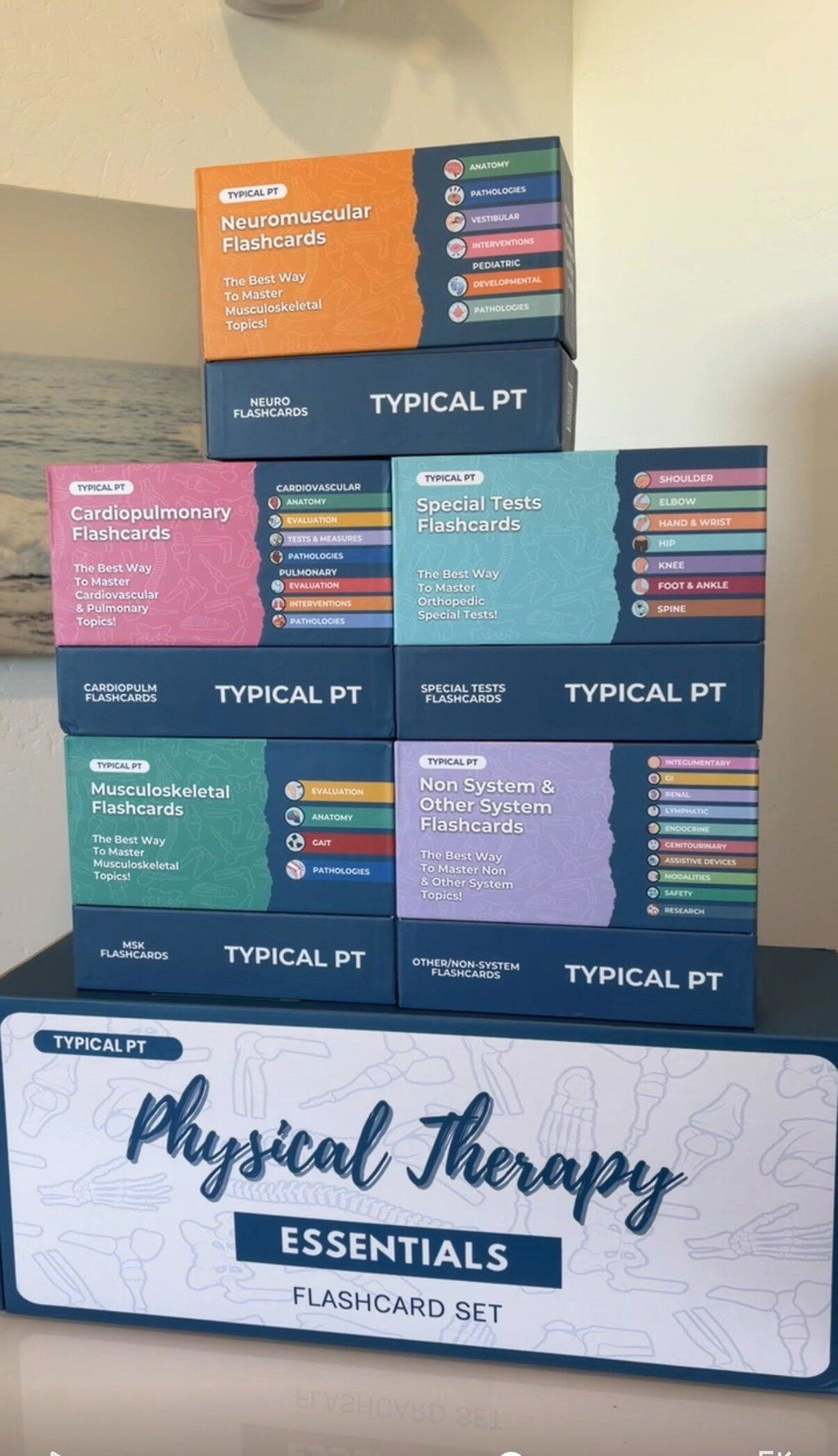
Say goodbye to overwhelming textbooks and hello to targeted, high-yield studying with 500+ premium flashcards in five color-coded boxes.
- 500+ cards in five color-coded boxes
- Guiding questions on the front, detailed visual answers on the back
- Tab cards with a table of contents for every section
- Mnemonics and memory tricks on the cards
- Built for school, fieldwork and board prep


Physical Therapy Essentials Flashcard Set
PASS THE NPTE FIRST TIME

The Physical Therapy Essentials book has been a fantastic resource for NPTE review. The visual aids, mnemonics, and 'Know This' features make high-yield information easy to remember and provided critical information tested on the NPTE. Highly recommend for any PT student, whether you're prepping for the NPTE, on clinicals, or in class!
What's Included

Memory Tricks & Mnemonics

No Fluff

Comparison Tables & Charts

Beautiful Custom Illustrations

Comprehensive Questions on Every Card

Know This/Quick Tips
- Special Tests
- Musculoskeletal
- Neuromuscular
- Pediatrics
- Cardiovascular
- Pulmonary
- Integumentary
- Gastrointestinal
- Genitourinary
- Renal
- Lymphatic
- Endocrine
- Assistive Devices
- Modalities
- Safety
- Research


Table of Contents
Everything you need to pass the NPTE
Subjects

Musculoskeletal
44 topicsEvaluation
- Screening tests
- Initial observation
- Spinal diseases
- Knee and ankle assessment
- Range of motion / MMT
- Palpation
- Dermatomes
- Dermatomes vs. Myotomes
- Deep tendon reflexes
- Joint play mobilization
- Outcome measures
Anatomy
- Convex on concave rules
- Temporomandibular joint
- Muscles of the upper body
- Anatomy of the spine
- Anatomy of the shoulder joint
- Scapular winging
- Anatomy of the elbow joint
- Anatomy of the hand and wrist joint
- Hand deformities
- Anatomy of the hip joint
- Anatomy of the knee joint
- Anatomy of the ankle joint
Gait
- Gait cycle
- Gait abnormalities
Pathologies
- Fractures
- Brachial plexus
- Cauda equina vs. Conus medullaris
- Osteoarthritis
- Rheumatoid arthritis
- Arthritis
- Ankylosing spondylitis
- Herniated disc
- Types of spondys
- Gout
- Osteoporosis
- Patellofemoral Pain Syndrome
- Patellar tendinitis
- Adhesive capsulitis
- Rotator cuff tears
- Scoliosis
- Total hip arthroplasty
- Total knee arthroplasty
- ACL / PCL rehabilitation

Neuromuscular
24 topicsAnatomy
- Anatomy of the brain
- Circle of Willis
- Cranial Nerves
- UMN vs. LMN syndrome
- Basal Ganglia vs. Cerebellum
- Babinski Reflex
Pathologies
- Traumatic Brain Injury (TBI)
- Stroke
- Lateral Medullary Syndrome
- Horner's Syndrome
- Spinal Cord Injuries
- SCI Interventions
- Pusher Syndrome
- Parkinson's Disease (PD)
- Multiple Sclerosis
- Guillain-Barre Syndrome
- Amyotrophic Lateral Sclerosis
- Myasthenia Gravis
- Bell's Palsy
- Bulbar Palsy
Vestibular
- Vestibular System & Vertigo
- Meniere's Disease vs. Vestibular Neuritis
Interventions
- Proprioceptive Neuromuscular Facilitation
- Nerve Glides

Pediatrics
12 topicsDevelopmental
- Pediatric Milestones
- Pediatric Reflexes
Pathologies
- Congenital Muscular Torticollis (CMT)
- Deformational Plagiocephaly (DP)
- Deformational Brachycephaly (DB)
- Down Syndrome
- Spinal Muscular Atrophy
- Muscular Dystrophy
- Spina Bifida
- Cerebral Palsy
- Lower Extremity Pathologies
- Upper Extremity Pathologies

Cardiovascular
18 topicsAnatomy
- Anatomy of the heart
- Important Structures and Blood Flow
Evaluation
- Heart sounds
- Vital signs
- Monitoring BP
- Cardiac equations
- RPE scale
- METS scale
- Important lab values
Test and Measures
- EKG
- Abnormal EKG
- Important biomarkers
- Cardiac medications
Pathologies
- Congestive Heart Failure
- Coronary Artery Disease (CAD)
- Angina
- Myocardial Infarction
- Metabolic & Respiratory Alkalosis/Acidosis

Pulmonary
13 topicsEvaluation
- Pulmonary anatomy
- Lung auscultation
- Lung sounds
- Pulmonary medications
- Pulmonary equations
Interventions
- Pulmonary interventions
- Airway clearance techniques
- Independent techniques
- Breathing techniques
Pathologies
- Restrictive vs. Obstructive Lung Diseases
- Chronic Obstructive Pulmonary Disease
- Pneumonia
- Asthma

Non-Systems
78 topicsIntegumentary
- Anatomy
- Anatomy of the skin
- Pathology
- Burns
- Ulcers
- Wounds
- Psoriasis
- Dermatitis
- Vitiligo
- Systemic lupus erythematosus
- Herpes
- Scleroderma
Gastrointestinal
- Anatomy
- Abdominal Quadrants
- Pathology
- Gastroesophageal Reflux Disease (GERD)
- Cholecystitis
- Peptic Ulcers
- Ulcerative Colitis vs. Crohn's Disease
- Types of Hernias
- Appendicitis vs. Diverticulitis
- Irritable Bowel Syndrome (IBS)
Renal
- Anatomy
- Anatomy of the kidney
- Pathology
- Acute vs. Chronic kidney disease
- Types of Incontinence
- Urinary Tract Infection
Lymphatic
- Anatomy
- The lymphatic system
- Lymph nodes
- Pathology
- Lymphedema
Endocrine
- Anatomy
- Endocrine System
- Hormones
- Pathology
- Addison's Disease vs. Cushing's Disease
- Hyper vs. Hypothyroidism
- Diabetes
Genitourinary
- Pathology
- Pregnancy
- Diastasis Recti
- Ectopic pregnancy
- HIV/AIDS
Assistive Devices
- K levels
- Prosthetics
- Types of assistive devices
- Types of walkers
- Types of crutches
- Types of canes
- Assistive Device Ambulation Patterns
- ADA Requirements
- AKA gait patterns
- BKA gait patterns
- Orthosis
- Transfemoral and Transtibial Amputation
Modalities
- Thermotherapy
- Cryotherapy
- Ultrasound
- Iontophoresis
- Cervical & Lumbar distraction
Safety
- Personal Protective Equipment (PPE)
Research
- Hierarchy of evidence
- Quantitative vs Qualitative research
- Types of Quantitative Studies
- Key definitions and concepts
- Descriptive Statistics
- Distribution curves
- Reliability vs. Validity
- Internal vs. External Validity
- Scales of Measurement
- Common Statistical Tests
- Sampling Methods
- Generalizability
- Sensitivity vs. Specificity of Diagnostic Tests
- Correlation: Positive vs. Negative
- Types of Graphs

Special Test
40 topicsShoulder
- Shoulder Impingement Tests
- Shoulder Dislocation Tests
- Rotator Cuff Pathologies
- Labrum Pathologies
- AC Joint Pathologies
- Thoracic Outlet Syndrome Tests
Elbow
- Biceps Pathologies
- Ligament Instability Tests
- Nerve Tests
- Medial Epicondylitis (Golfer's Elbow)
- Lateral Epicondylitis (Tennis Elbow)
Hand & Wrist
- De Quervain's Syndrome
- Triangular Fibrocartilage Complex (TFCC) Instability
- Ulnar Nerve Pathologies
- Carpal Tunnel Syndrome (CTS)
Hip
- Labrum Pathologies
- Femoral anteversion Tests
- Contracture Tests
Knee
- Meniscus Injuries
- MCL Injury
- LCL Injury
- ACL Injury
- PCL Injury
- IT Band Tests
- Patellofemoral Tests
Foot & Ankle
- Instability Test
- Sprain Tests
- Plantar fasciitis Tests
- DVT Tests
- Neural Tests
Spine
- Sacroiliac
- Laslett's Cluster
- Cervical
- Neural Tests
- Disk/Facet Pathologies
- Cardiovascular Tests
- Structural Tests
- Hyper/Hypomobility Tests
- Lumbar
- Disk/Facet Pathologies
Details
Find answers to common questions about our product.
Product Specification
Size: 16.1″ x 6.3″ x 5.1″ — 5-Box Flashcard Set | Weight: 9.3 lbs
Format: Premium study card system designed for use from Day 1 of PT school through board prep
This physical flashcard set is built for the long haul — 500+ cards organized across 5 specialized boxes, each covering a major NPTE content area. Every card features custom illustrations, tables, and charts that break down complex topics visually, along with built-in mnemonics and memory tricks so you don’t have to make your own. “Know This” boxes on each card highlight the high-yield information most commonly tested on the NPTE. Written and designed by licensed physical therapists.
Also included separately in the package:
- Complete the Set: Add the Anatomy Flashcards (sold separately)
Details:
- 500+ premium flashcards across 5 specialized boxes
- Covers every major NPTE content area
- Custom illustrations, tables, and charts on every card
- Built-in mnemonics and “Know This” high-yield callout boxes
- Written and designed by licensed physical therapists
- Ready to use from Day 1 through board prep — no card-making required
Please note: This product is a physical copy only. Digital versions are not included.
Shipping Information
We offer two shipping options at checkout:
- Free Standard Shipping — Estimated delivery in 5–7 business days
- Fast Shipping ($10) — Estimated delivery in 2–3 business days
Business days do not include weekends or holidays. Tracking information will be provided via email once your order ships.
Please Note: Once your order is placed, we are unable to change the shipping address, so please double-check your details before completing your purchase.
Ask A Question
Real Students, Real Reviews
Heard It From Our Students
PT students share their honest take on the Physical Therapy Essentials Flashcard Set.
Alina Soto
Matthew Priest
Shelsy
Real Reviews from Real Physical Therapists
Frequently asked questions
How many flashcards are included in the set?
The set includes over 500 premium flashcards organized across 5 specialized boxes: Musculoskeletal, Neuromuscular/Pediatrics, Cardiopulmonary, Other/Non-Systems, and Special Tests.
What topics do the flashcards cover?
The flashcards cover every major content area tested on the NPTE, including musculoskeletal, neuromuscular, pediatrics, cardiovascular, pulmonary, integumentary, gastrointestinal, genitourinary, renal, lymphatic, endocrine, assistive devices, modalities, special tests, safety, and research.
Can I buy individual boxes separately?
No. The flashcards are only available as a complete 5-box set. However, you can add the Anatomy Flashcards as an optional add-on at checkout.
Are the Anatomy Flashcards included in the set?
The Anatomy Flashcards are not included in the base set. They are available as a separate add-on that you can include with your purchase.
What is on the front and back of each card?
The front of each card features a comprehensive, clinically focused question. The back includes the answer along with custom illustrations, comparison tables and charts, mnemonics and memory tricks, and "Know This" quick tips boxes highlighting high-yield information commonly tested on the NPTE.
Are these flashcards aligned with the current NPTE exam?
Yes. The content is organized to align with the current NPTE content outline, and the "Know This" boxes specifically highlight topics and concepts that are commonly tested on the exam.
Can I use these during my DPT program, or are they only for NPTE prep?
Both. The flashcards are designed so you can start using them from your first semester of PT school alongside your coursework. Each box corresponds to a major content area, so you can study the relevant box as you move through your curriculum. They also serve as a comprehensive review tool when you begin preparing for the NPTE.
Who created these flashcards?
The flashcards were written and designed by licensed physical therapists and university professors with expertise in NPTE preparation and PT education.
What makes these different from free flashcard apps like Anki or Quizlet?
These are professionally designed physical flashcards with custom illustrations, comparison charts, built-in mnemonics, and high-yield NPTE tips on every card. Unlike user-generated digital decks, every card has been vetted for accuracy and organized by system. You don't have to spend time building, organizing, or verifying your own cards.
What is your refund policy?
All sales are final once the packaging has been opened. Because the flashcards are a physical product, we are unable to offer refunds or exchanges after the set has been unsealed. We encourage you to review all product details and previews on this page before purchasing.
How will my flashcards be shipped?
All orders are shipped via USPS or UPS within 5–7 business days.
Can I bundle the flashcards with other Typical Prep products?
Yes! The flashcards can be bundled with other Typical Prep products including the PT Essentials Book and the NPTE Adaptive Platform. Visit our bundle page to see available options and pricing.
A
As a new third year student, these flashcards have been the perfect study tool during the beginnnig of my NPTE prep journey. I currently utilize them to brush up on topics/systems that need review as well as for pre clinical preparation. The quality of the cards is INCREDIBLE and the pictures/charts make them easilly digestible. I would hands down recommend these to my friends in my program for their NPTE prep!
M
As a PT student who is about to begin my final year of PT School, these flashcards have been very helpful. They contain all of the important information that is covered in my classes and have been great to review with as I prepare for the NPTE this upcoming year.